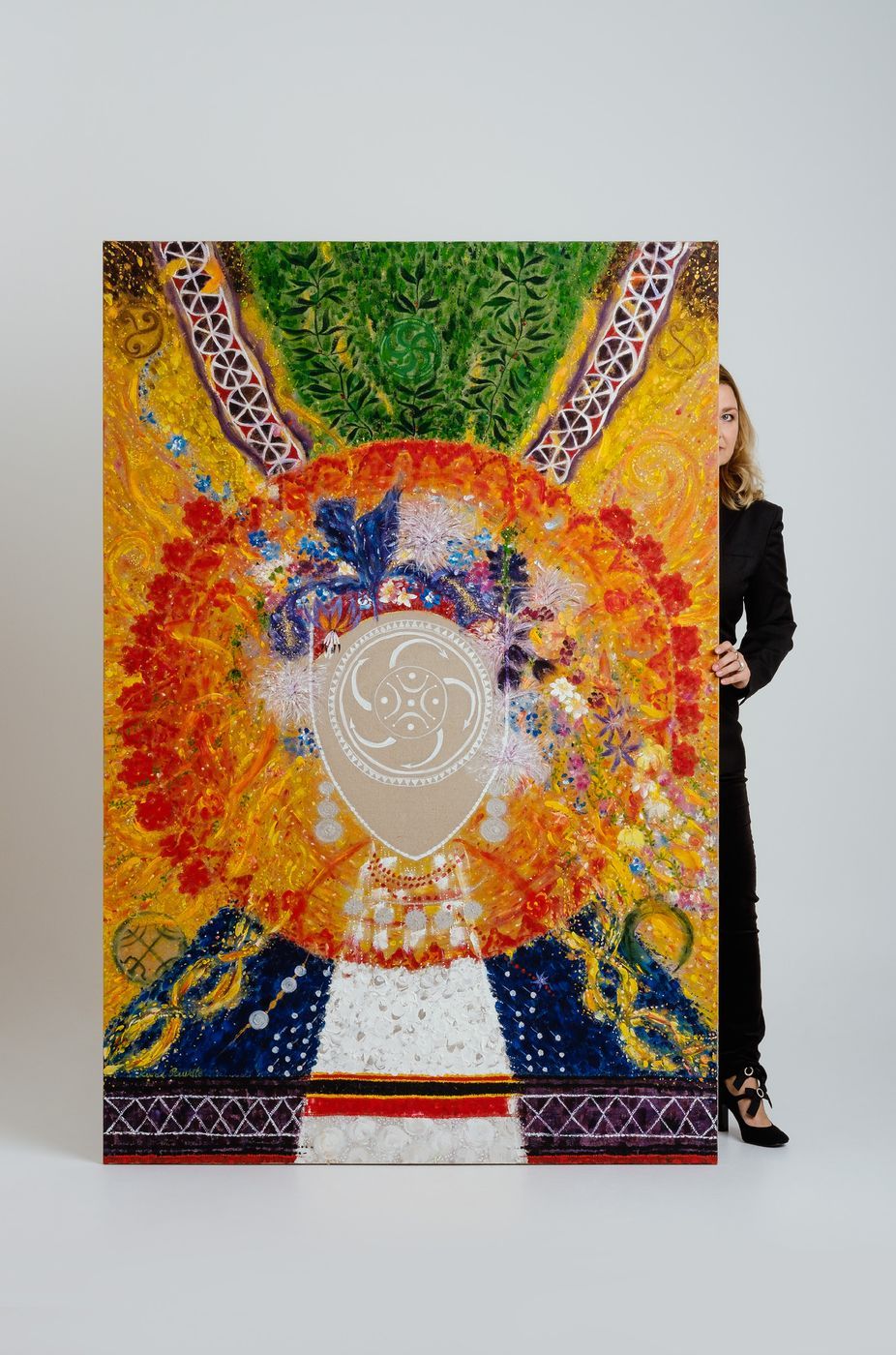
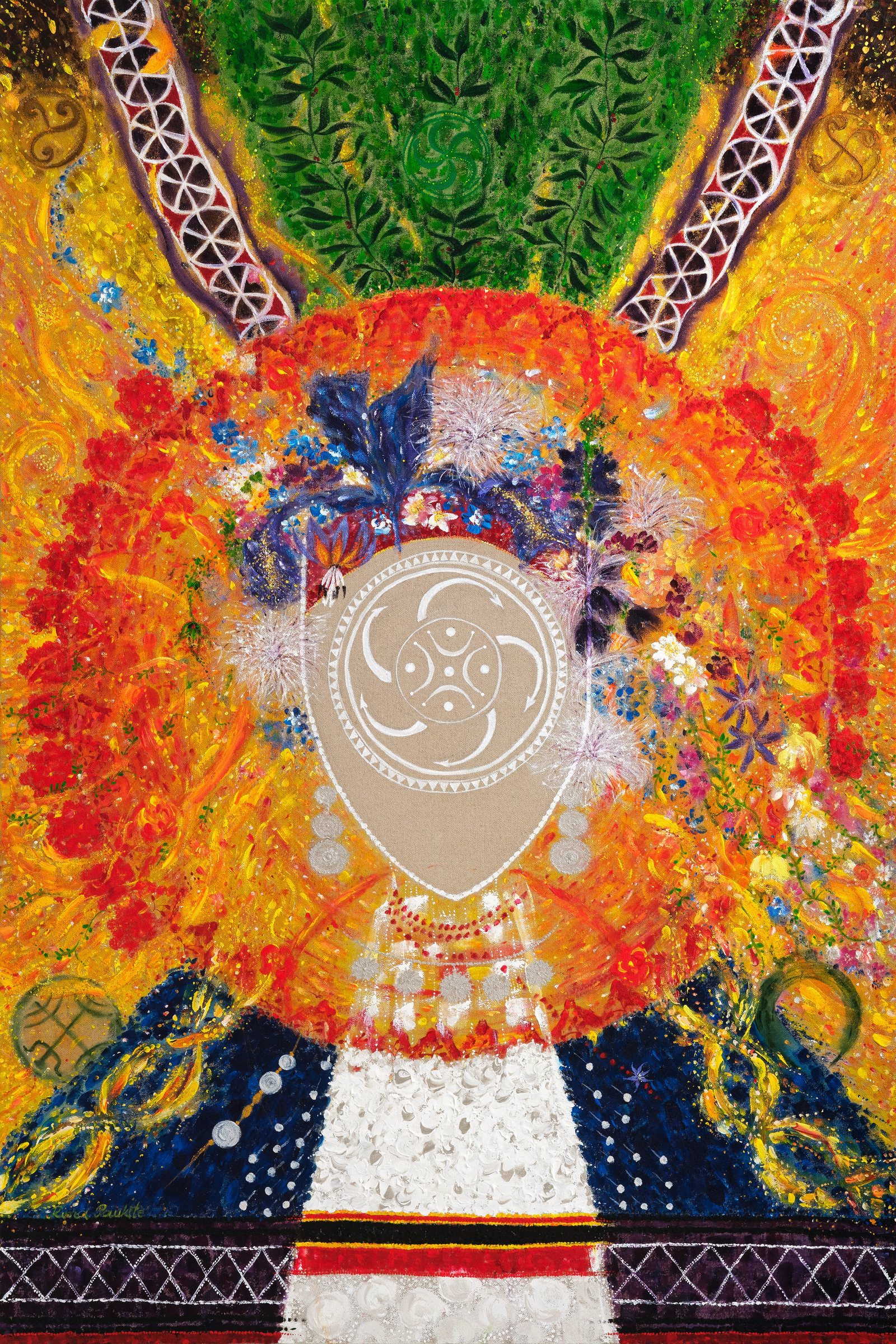
The Woman–Sun in Bloom, Sharing Her Warmth and Love
- Collection
- Woman in Patterns — Spain
- Region
- Cantabria
- Year
- 2023
- Medium
- Acrylic on natural linen canvas
- Dimensions
- 195 × 130 cm
Artist-Signed Fine Art Print
A fine-art reproduction of the original painting, hand-signed by Rima Paukste. Clearly distinguished from the original acrylic on linen.
All prices include VAT and complimentary shipping to eligible continental European destinations.
For delivery outside our standard European shipping area, please contact us for a personalised shipping quotation.
Delivery within 2–4 weeks of the order date · rolled canvas, unstretched and unframed · Certificate of Authenticity included
Print details
Each print bears the artist's original handwritten signature, applied by hand — never a reproduced signature.
Premium Quality Canvas
We use premium-quality, exceptionally durable white canvas with a refined, natural fabric texture. This carefully selected material ensures outstanding colour accuracy, faithfully reproducing every shade and subtle nuance of the original artwork.
Each piece is printed using advanced 12-colour printing technology with genuine, eco-friendly, odourless inks. The result is rich, vibrant colours, exceptionally smooth tonal transitions, and a beautifully matte finish that captures delicate shadows and the finest details.
The ink manufacturer guarantees over 100 years of fade resistance, ensuring that the artwork retains its original beauty and colour intensity for generations.
Shipping & Presentation
Each artwork is carefully packaged and delivered by post or courier service within 2–4 weeks of the order date.
The canvas is supplied unstretched and unframed, carefully rolled for safe transportation and ready to be stretched onto a wooden stretcher frame.
Every artwork is accompanied by an original Certificate of Authenticity, certifying the authenticity of the artist's work.
Original Artwork — Price Upon Request
Originals are offered by private enquiry. Shipping, insurance and installation are arranged individually.
The woman who is the sun in bloom, shining in her own home! The woman who brings joy and health into your life! Her magical circle continually spins, embracing everyone with warmth. The Cantabria Woman embodies health and love within your home and heart.
In Cantabria, various Celtic deities were revered:
Nantosuelta, the goddess of fertility and prosperity, often depicted with a cornucopia and a serpent.
Continue reading
Belisama, the goddess of light and fire, and protector of craftsmen and metalworkers.
Epona, the goddess of horses and animals, considered the guardian of travelers.
Taranis, the god of thunder and lightning, associated with power and war.
Sirona, the goddess of healing, linked with hot springs and natural springs.
These deities were worshipped through rituals, sacrifices, and festivals, each with their own unique attributes and manifestations.
The Sun is one of the most powerful deities, representing life, fertility, warmth, and health.
It loves all people equally, shining its light on everyone. The Sun's life was believed to be eternal, without end. It is born in winter and grows and matures throughout the year, until winter returns once more.
A dot represents the beginning, the origin of everything.
A cross is a magical ornament motif, a symbol of fire. It is characteristic of many ancient cultures.
A circle is a symbol of the Sun, sometimes surrounded by sunbeams. It also represents fire, perfection and eternity, fidelity.
A sphere radiates power and wholeness from its centre in all directions. This symbolism, represented by the sphere and the spool, suggests that happiness was viewed as an inner power – a divine blessing on which everything else relied. This included uplifting feelings like cheerfulness, joy, and love, a large and supportive family, friends, and, of course, material wealth – a richly furnished home filled with everything one could desire.
The simple straight line represents Žemyna, the goddess Earth or Mother Earth.
A curved line is a symbol of fertility, a symbol of the womb, wealth, and happiness.
The plant motifs symbolise the renewal of life that arises from the interaction between the masculine element of heaven and the feminine element of earth.
Three in one. The Celtic sign of the triskelion is considered a powerful symbol of energy.
It symbolises life, death, and rebirth, as well as the three forces of nature: earth, air, and water.
The three inner circles represent femininity and fertility.
The triskelion, also known as a triskeles, is a Celtic curvilinear geometric symbol composed of three spiral rods converging at a central point, forming a circle or triangle in a spiral configuration. It bears a resemblance to a swastika or a tetrasquel, with the latter distinguished by its four arms. In Celtic culture, the number three is the most sacred, representing perfection and balance. Triskelions have been discovered throughout human history, underscoring their timeless appeal. These symbols can be found in some areas of Spain, such as Galicia, Cantabria, Asturias, and the Basque Country.
[A picture containing circle, art, drawing, pattern Description automatically generated]
A spiral is one of humanity's oldest symbols, deeply connected to the sun, life, and reincarnation. It represents the sun's trajectory across the sky over three months. The triple spiral, spanning nine months, symbolises the womb of Mother Earth and the nature of energy. The constant movement of time. Mother Earth, reminiscent of the interrelationship between earth, water, and sky.
In ancient times, the Cantabrians worshipped the oak tree, yews, forests, and celestial elements like the moon, the immortality of the soul, as well as the sun, the symbol of earthly life and the sky (Lugo).
The Valnera Mountains in eastern Cantabria are home to several unique flower species found only in this region, attracting naturalists and botanists from all over Europe. Some of these rare flowers are depicted in the painting, inspired by the image of the Cantabrian goddess La Anjana). She is portrayed wearing a wreath of wildflowers and braided hair. La Anjana comes to life near streams, emerging from waterfalls and springs, walking forest paths. She tends to injured animals, trees broken by storms, lovers, those lost in the woods or snow, the poor, and the suffering. A benevolent figure, she wanders through villages, leaving gifts at doors but punishing wrongdoers. La Anjana is said to have an underground palace where she keeps wonderful treasures. At Christmas, she brings gifts of shoes and clothes to the poor. This goddess of Cantabrian mythology is closely related to the goddesses of Asturian, Leonese, Galician, and Basque mythology.
Enjoy the happiness in sunny love!
The colours
- Red is the colour of activity and energy, embodying the vibrancy of spring life.
- Black, the colour of the earth, represents life and has long been associated with the Mother Goddess.
- Yellow is the colour of the Sun and gold, implying radiance, shimmer, and glow, reminiscent of gold, silver, and copper.
- White denotes holiness. It stands for the capacity to be calm, beautiful, harmonious, foster harmonious relationships, and remain healthy and integral.
- Blue symbolises eternity.The spruce pattern – the upward-pointing branches (resembling a herringbone) symbolise life.