Woman in Patterns
An exhibition essay on women, ornament and cultural memory.
Patterns as a language
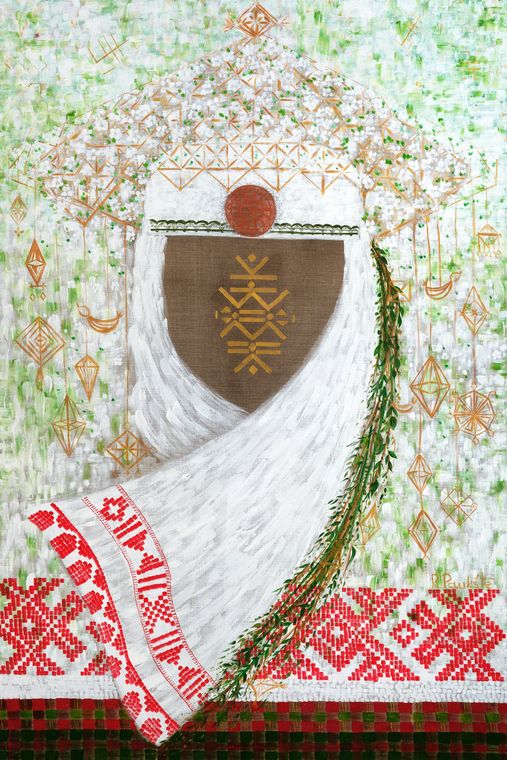
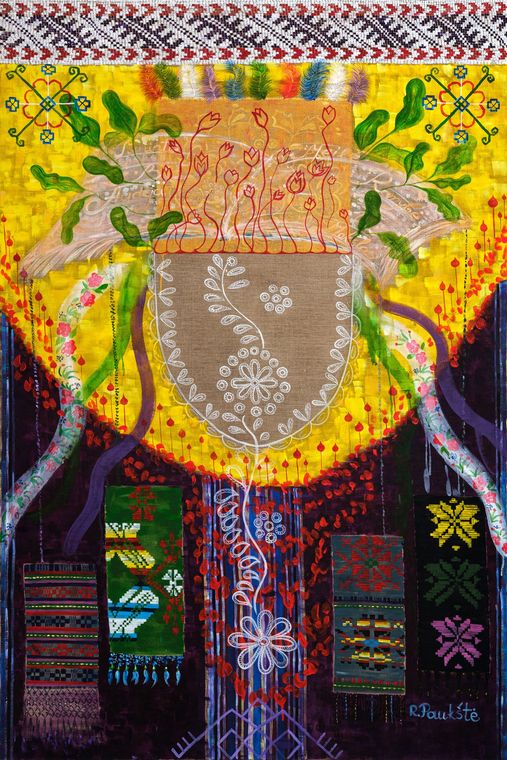
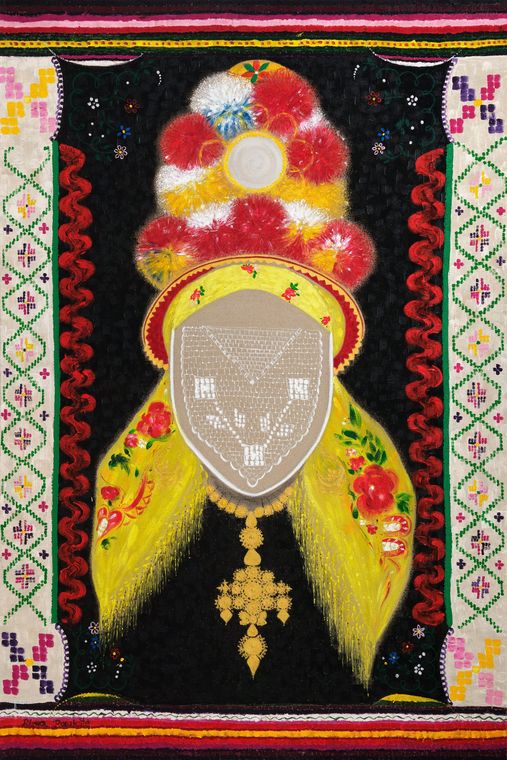
The idea that unites the collection is the folk pattern. For Rima Paukste, ornament is not decoration added to a surface but a language: it symbolises the spirit of a people and the spirit of a person. Each motif — the dot from which everything begins, the rhombus of the fertile earth, the rotated cross that protects the one who stands between heaven and earth — is a word in that language.
In the paintings these words are assembled with care. The colours of the regional costume, the patterns of its weaving and the symbols of its decoration are combined so that each canvas conveys the authenticity of a single place.
The woman as creator and guardian
“Why woman?” the artist asks. Her answer is that woman is the spirit of the earth and of the family: she creates beauty and gives life so that life may continue to create. It is she who, since ancient times, has made the patterns — and with them her own character — by weaving, embroidering, drawing, knotting, crocheting and knitting.
A pattern, like a woman’s face, reflects the place where she lives: where she loves, sacrifices, gives birth, works and breathes deeply. Through it she passes on her thoughts and experience, her joy of life, her femininity, her secret and her inner strength.
A connection between generations
Patterns handed down by women from generation to generation link one generation with the next. Like a language, they strengthen the bonds between them and preserve the legacy each one leaves behind. The paintings follow the stages of a woman’s life — youth, marriage, motherhood, maturity, wisdom — and the cycle that returns life to the earth and renews it.
“Patterns, much like a woman’s face, reflect the place where she lives.”
Symbol and history
Behind every work lies research into history, ethnography and mythology: Baltic goddesses of fire, earth and water such as Gabija, Žemyna and Mara; the Basque goddess Mari; the myrtle of Murcia; the Carthaginian Tanit of Ibiza; the bridal crowns of the Klaipėda region and the doncellas of La Rioja. Old beliefs are not illustrated but woven into the ornament itself, so that the viewer can read the painting as one might read a textile.
Lithuania and Spain: one European heritage
The two parts of the cycle — ten paintings for Lithuania’s historical regions, seventeen for Spain’s autonomous communities — are conceived as a dialogue. The nations of the world are different, the artist writes, yet they are united by the language of patterns: since ancient times peoples have travelled and passed on their culture, mixing with and enriching one another.
Seen together, the Baltic sun-rosette and the Iberian embroidered flower, the Lithuanian woven sash and the Spanish regional costume speak of a shared European inheritance in which women have always been the principal authors.
Contemporary painting, traditional sign
The cycle is contemporary in its scale, its composition and its idea, while its vocabulary is centuries old. Painted in acrylic on natural linen — the very fibre of so much traditional weaving — each 195 × 130 cm canvas presents a single, frontal figure whose face is left open. The woman is less a portrait than a vessel for her region’s memory, and an invitation to recognise oneself in it.
The collection Woman in Patterns is my tribute to every Woman — those who have been, those who are, and those who are yet to come.
— Rima Paukste