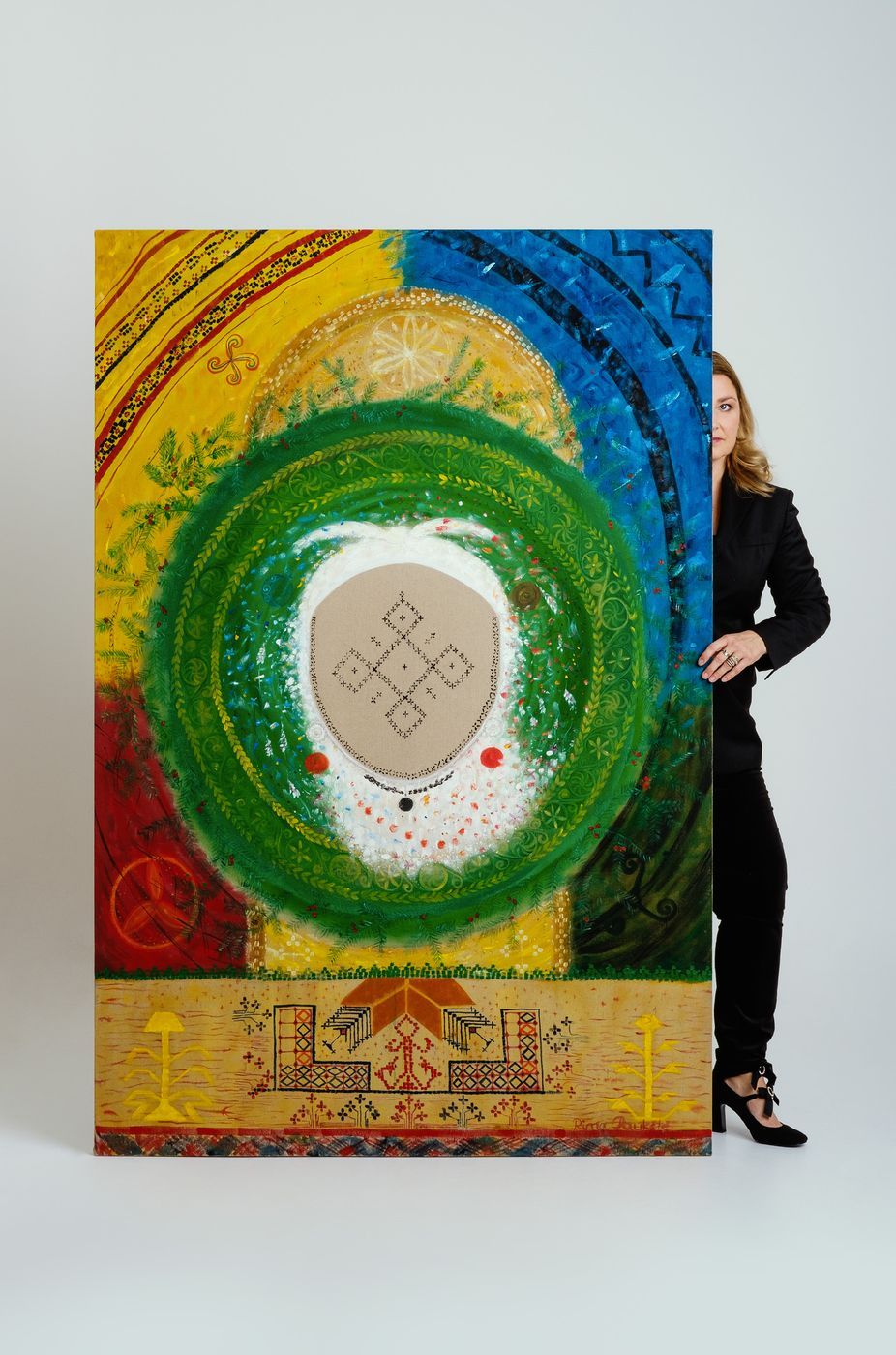
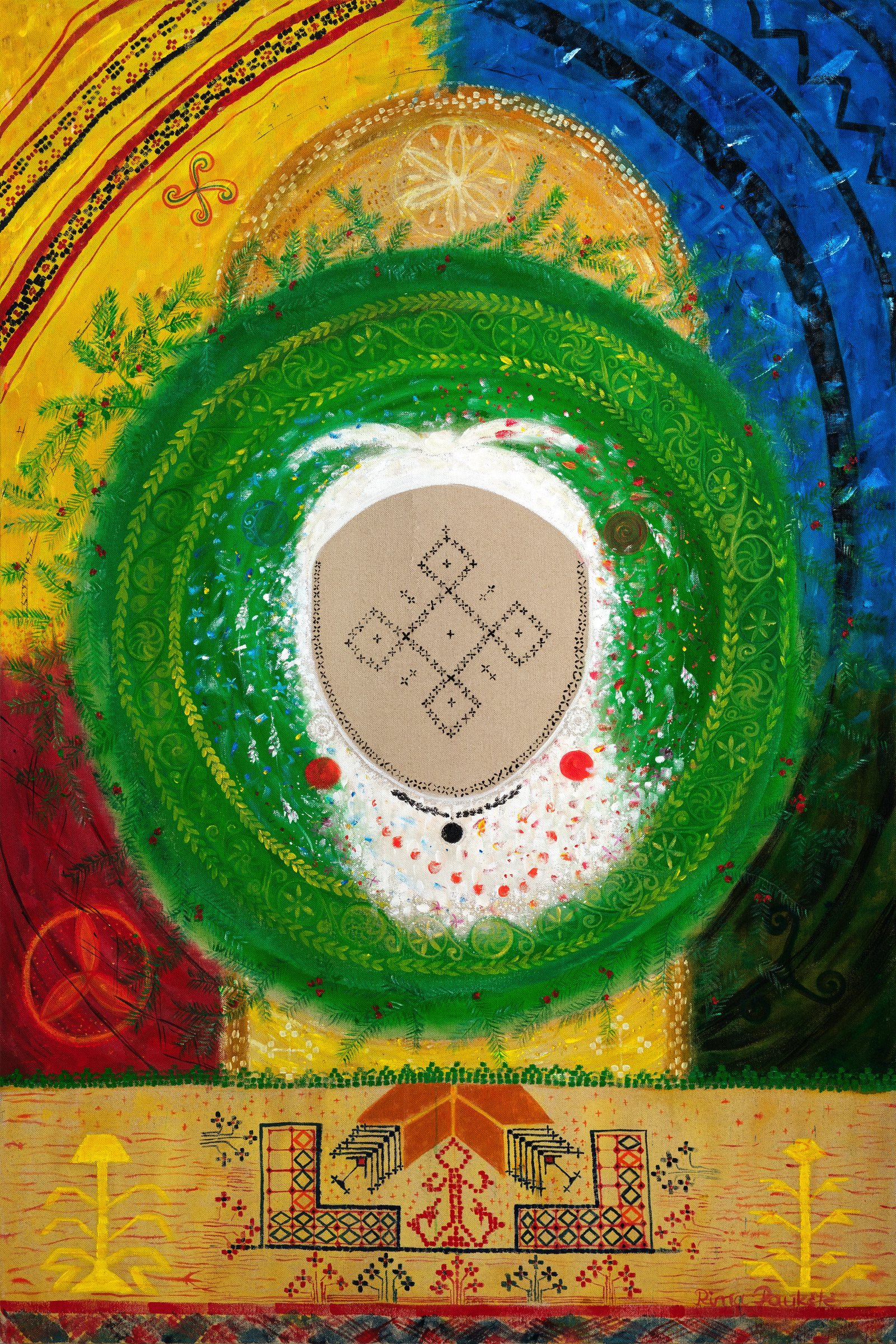
The Woman of the Green Mountains
- Collection
- Woman in Patterns — Spain
- Region
- Asturias
- Year
- 2020
- Medium
- Acrylic on natural linen canvas
- Dimensions
- 195 × 130 cm
Artist-Signed Fine Art Print
A fine-art reproduction of the original painting, hand-signed by Rima Paukste. Clearly distinguished from the original acrylic on linen.
All prices include VAT and complimentary shipping to eligible continental European destinations.
For delivery outside our standard European shipping area, please contact us for a personalised shipping quotation.
Delivery within 2–4 weeks of the order date · rolled canvas, unstretched and unframed · Certificate of Authenticity included
Print details
Each print bears the artist's original handwritten signature, applied by hand — never a reproduced signature.
Premium Quality Canvas
We use premium-quality, exceptionally durable white canvas with a refined, natural fabric texture. This carefully selected material ensures outstanding colour accuracy, faithfully reproducing every shade and subtle nuance of the original artwork.
Each piece is printed using advanced 12-colour printing technology with genuine, eco-friendly, odourless inks. The result is rich, vibrant colours, exceptionally smooth tonal transitions, and a beautifully matte finish that captures delicate shadows and the finest details.
The ink manufacturer guarantees over 100 years of fade resistance, ensuring that the artwork retains its original beauty and colour intensity for generations.
Shipping & Presentation
Each artwork is carefully packaged and delivered by post or courier service within 2–4 weeks of the order date.
The canvas is supplied unstretched and unframed, carefully rolled for safe transportation and ready to be stretched onto a wooden stretcher frame.
Every artwork is accompanied by an original Certificate of Authenticity, certifying the authenticity of the artist's work.
Original Artwork — Price Upon Request
Originals are offered by private enquiry. Shipping, insurance and installation are arranged individually.
The green mountains are her home, a place where abundance is ever-present. She is always hospitable and cheerful, with a heart as brave as it is kind. Her laughter is so loud and joyful that it echoes through her household and across the mountain tops, reaching the misty ocean. With her laughter, she clears the fog. Following the Sun's path, she leads you to a door that opens into a wonderland filled with mysteries and mystical creatures. She guides us to the Tree of Wisdom, where we meet our ancestors, who fill us with knowledge and brighten our hearts, showing us the way forward.
She is a truly special Woman!
Asturias is known as the most mountainous region in Spain.
Continue reading
Asturian patterns are characterised by geometric designs, featuring simple, chequered, and rhombic motifs in vibrant, autumnal hues.
Central to this culture is the Celtic Tree of Life, revered as the most significant sacred symbol, representing their gods and the energy of nature. It stands for harmony and balance.
Trees held profound significance for the ancient Asturians, serving not only as sources of protection, shelter, and firewood, but also as sacred spaces for signing treaties, negotiating, performing rituals, weddings, and oaths. For the Druid priests of Asturias, trees were central to their teachings about the world, especially in the knowledge of plants used for medicines and potions. Trees were regarded as sacred witnesses to human activity.
In Celtic culture, the concept of the universe was divided into three worlds: "keugant," "abred," and "gwenved," with the Tree of Life serving as a part of them.
This sacred tree formed the central axis of the world, connecting the three levels of the cosmos: the underground through its roots, the earth's surface through its trunk, and the sky through its branches, leaves, and crown.
Druids believed that both men and women carried a symbolic tree within them, enabling them to gain wisdom and knowledge.
The Tree of Life was more than just a symbol; it was a connection to the spirit world, with its branches touching the heavens and its roots reaching deep into the realm of the dead. The knowledge of this sacred tree has been passed down orally through generations and continues to be revered to this day.
The star – the dawn star – symbolises light. In the painting, above the doorway arch, it represents the gateway to a realm filled with magical light, knowledge, happiness, and wisdom.
The spruce pattern is associated with the goddess Laima, who embodies creativity and sensitivity.
A cross marks the star, the relationship between spirit (heaven, God) and matter (earth). It is a sign of fire, a source of energy and power that nourishes the earth and human being.
A rosette, a little star is the tree of life, love, beauty and health.
Varnaakis – the eye of the crow – signifies fertility, the earth, and the "navel of the world."
A dot is the beginning and the ending of everything,
In folklore, the Sun is called the mother, the wheel-rider, the white sheep. She is depicted as a virgin or a woman wearing silver shoes and a crown. She also represents fire, perfection and eternity, fidelity. People traced the Sun's path, marking and celebrating the equinoxes and solstices. The most significant days, like Midsummer and Christmas, were closely linked to the Sun. She was revered as the giver of life and was often seen as the wife or sister of the Moon.
In mythology, there are seven daughters of the Sun, representing the stars and major planets, with Venus being the most renowned among them.
The stars were also believed to embody the spirits of living people. It was thought that when a person is born, their star lights up, and a thread of life is attached to it. Upon death, the star would fall, the thread would break, and the spirit would travel along the Milky Way, marking its journey into the afterlife.
A segmented star (hexagonal star) star is the symbol of the sun. Decorated items include tools, distaffs, and beaters. It is one of the world's oldest symbols of the sun and light.
The bird, symbolising the connection between heaven and earth, was associated with constant movement.
The well, in turn, represents the symmetry of the world. In its water, the World Tree is reflected to the world beyond. The well, much like a spring, is considered the "eye of the earth," serving as an opening to the underworld. It is a place where one can glimpse their future and destiny. In the past, girls used to meet at the well for magic rituals.
The Virgin, the goddess Mari, is revered as the goddess of both earth and sky.
In the painting, the circle depicted is a wreath made from the yew tree, adorned with its green leaves and red berries. The yew tree, often called the Tree of Life, is celebrated for its healing properties. It was highly revered by the Asturians and worshipped by the ancient Celtic gods. Around the yew tree, tribal gatherings, major life events, and rituals were held, and it also served as a place for administering justice. The Celts recognised that the yew tree's substances could be both a deadly poison and a powerful healing agent, making it a sacred symbol of the cycles of life and death.
Interestingly, the expression of "throwing yew" – “tirar los tejos” in Spanish – originates from a Celtic custom practised during the summer solstice, when young women would throw yew seeds at men they were attracted to.