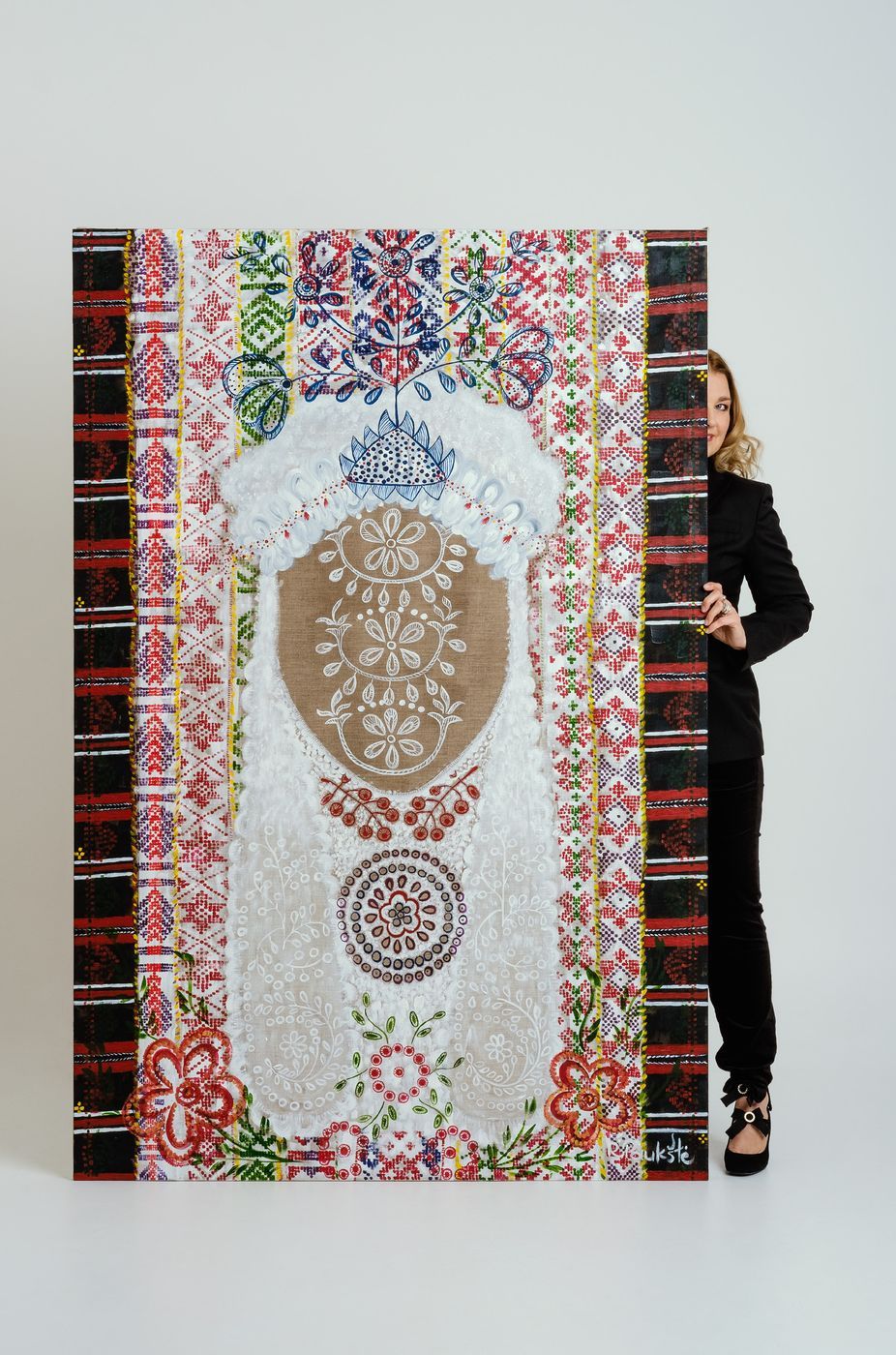
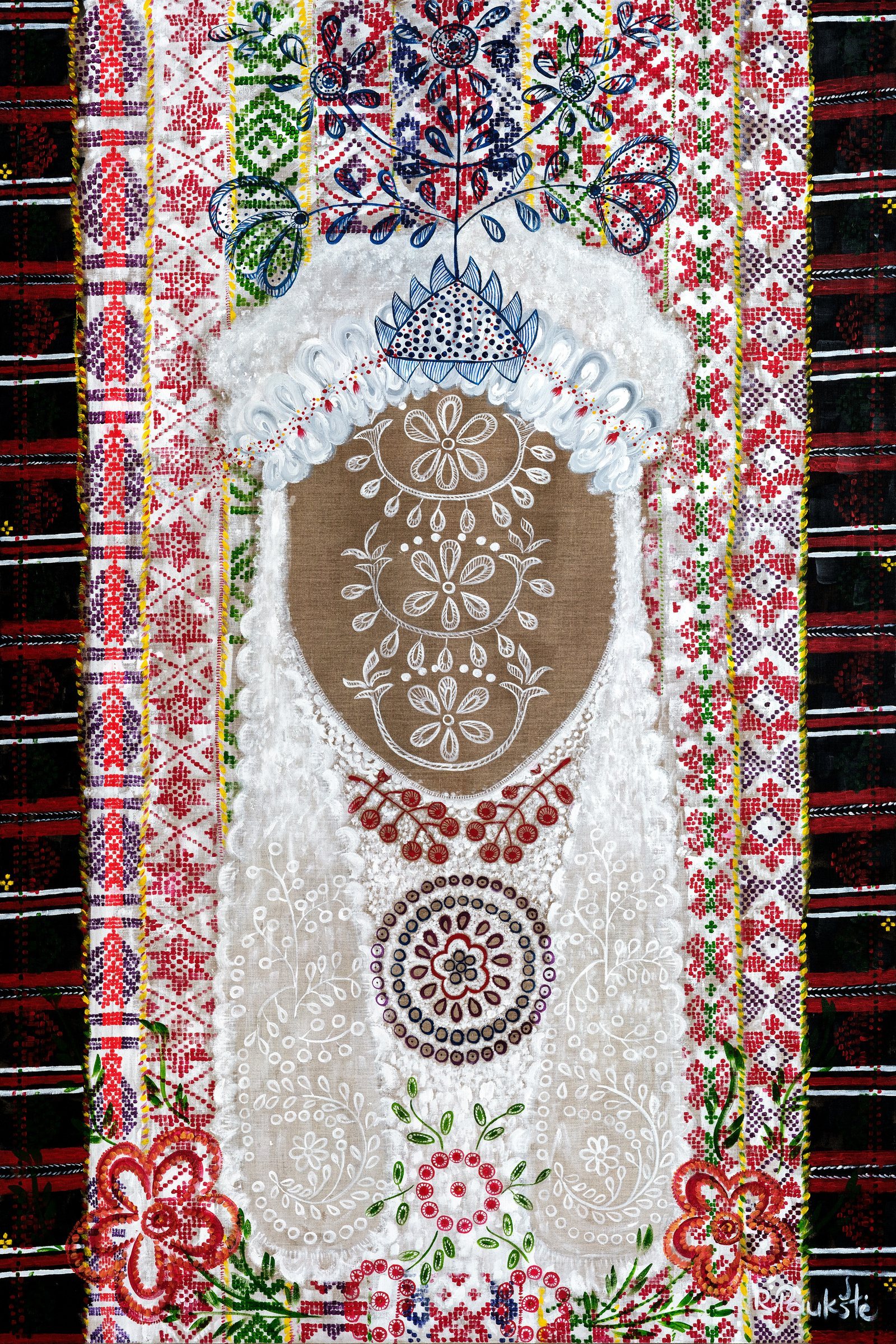
The Woman Who Sings in Patterns
Moteris, dainuojanti raštais
- Collection
- Woman in Patterns — Lithuania
- Region
- Dzūkija
- Year
- 2017
- Medium
- Acrylic on natural linen canvas
- Dimensions
- 195 × 130 cm
Artist-Signed Fine Art Print
A fine-art reproduction of the original painting, hand-signed by Rima Paukste. Clearly distinguished from the original acrylic on linen.
All prices include VAT and complimentary shipping to eligible continental European destinations.
For delivery outside our standard European shipping area, please contact us for a personalised shipping quotation.
Delivery within 2–4 weeks of the order date · rolled canvas, unstretched and unframed · Certificate of Authenticity included
Print details
Each print bears the artist's original handwritten signature, applied by hand — never a reproduced signature.
Premium Quality Canvas
We use premium-quality, exceptionally durable white canvas with a refined, natural fabric texture. This carefully selected material ensures outstanding colour accuracy, faithfully reproducing every shade and subtle nuance of the original artwork.
Each piece is printed using advanced 12-colour printing technology with genuine, eco-friendly, odourless inks. The result is rich, vibrant colours, exceptionally smooth tonal transitions, and a beautifully matte finish that captures delicate shadows and the finest details.
The ink manufacturer guarantees over 100 years of fade resistance, ensuring that the artwork retains its original beauty and colour intensity for generations.
Shipping & Presentation
Each artwork is carefully packaged and delivered by post or courier service within 2–4 weeks of the order date.
The canvas is supplied unstretched and unframed, carefully rolled for safe transportation and ready to be stretched onto a wooden stretcher frame.
Every artwork is accompanied by an original Certificate of Authenticity, certifying the authenticity of the artist's work.
Original Artwork — Price Upon Request
Originals are offered by private enquiry. Shipping, insurance and installation are arranged individually.
Oh, the abundance of your colourful woven sashes! So many words are spoken through each of them.
Love has manifested itself in you, and your smile is full of joy.
Oh, the abundance of sashes! So many detailed patterns! They tell the story of the Woman's world, a world that she deeply feels out, understands and passes on to her offspring. She is diligent. She is hard-working. Every inch of her craft is meticulously refined, honed and infused with her heartfelt dedication.
Continue reading
In Lithuanian mythology, the woven sash is a link to the higher world, an intermediary – in the broadest sense possible.
In the painting, the Woman's hood is white. It is her holiness, peace, and gentleness.
The background of the painting features the traditional sashes of Dzūkija. They reflect the patterns typical of the region. In Lithuanian mythology, the female deities Laima and Laumė are associated with the weaving of sashes, and women of Dzūkija were especially famous for weaving and tying them. That is why the painting is richly adorned with sashes.
A triangle, open downwards (the heavenly shelter), is the roof of the world, the spiritual guardian.
A dot is the star, the grain, the seed. It symbolises the beginning of the beginnings. It is the all-in-one, the source of light, the centre, the individuality, being the one and only.
A rotated cross – two lines crisscrossed with each other – is the knot of life, the eternal happiness. It means protection and blessing. The rotated cross – the knot – symbolises a person who is affected and protected by the forces of heaven and earth. At the same time, the person is the link between the two. The arrow from above signifies heavenly protection and the arrow from below indicates the earthly forces acting on the person. At the intersection of these "above" and "below" powers, the person finds themselves at a point of transformation, in a dangerous, precarious state – yet at the same time protected and sheltered both by the "above" and the "below". The knot has the significance of magical protection. It is the meeting point of the powers of heaven and earth. It is a symbol of transformation, indicating a change, a shift from one stage of life to another. The moment of transformation is precisely that point of intersection between two different states. It is a symbol that reminds us of the necessity of human change – inner, spiritual, outer. It is the sign of the stars, the fire.
A segmented star (hexagonal star) is one of the world's oldest symbols of the Sun and light, known in many countries. It has also been called the sun, the star, and the rosette.
A circle symbolises the Sun, often depicted with sunbeams radiating from it. In the intersections of the crosses, the sun "shines". It also signifies fire, perfection, eternity, and fidelity. Indeed, the wedding ring, too, is a circle.
The symbolic pattern of horses – known as žirgeliai – is a symmetrical combination of triangles, angles and crossed flails. They represent prosperity and happiness, fertility and good harvests. In some places, the corners of the horses are pointing upwards, in others, downwards. The upward angles imply the heaven's roof, the divine protection. Downward angles stand for fertility and fruitfulness. The double combination of triangles and angles is used as a decorative element, believed to bring good luck.
A rhombus (an eye, the eye of the crow) symbolises fertility, the earth, "the navel of the world". In Lithuanian ornaments, the Sun is depicted as a sprouted rhombus, which by weavers is also referred to as a rose, a rosette, a rosehip. The Sun was seen as the blossom of the Tree of Life. This blossom represents love, beauty, health, and youth.
A rosette is the Tree of Life, love, beauty, and health. The symbol of the rosette (a jagged rhombus) represents the sun and flora. In Dzūkija, people referred to the jagged rhombus as a small apple. The apple gives immortality and eternal youth, and symbolises fertility, the continuation of the family and love.
The lines in the spruce pattern (similar to a herringbone) are signs of the goddess Laima. She inspires creativity and sensitivity. Laima brings a sense of love for our land and family, respect for our elders and neighbours.
Swastika is a dynamic cross-shaped sign of the Sun, Perkūnas (the god of thunder), fire, power, and movement. Baltic people/Aesti also associated these signs with happiness, light, and goodness. Swastikas come in two types: rightward or leftward. The snapped ends of the cross signified the movement of this celestial luminary. The pattern of the swastika signifies vitality, rebirth and renewal.
The painting depicts a tree or a flower (a vigorous plant). Here, it grows out of the earth, out of the pot, out of the heart. In folk art, this plant is called the Tree of Life and represents the power of the earth to give birth to life, the fruit that emerges from it.
The six-petalled sign is the symbol of the Sun.
The colours
- Red is the colour of activity and energy, representing the vibrant life of spring.
- Black is the colour of the earth. It represents life and has always been the colour of the Mother Goddess.
- Yellow is the colour of the Sun and gold, implying radiance, shimmer, and glow, reminiscent of gold, silver, and copper.
- White denotes holiness. It stands for the capacity to be calm, beautiful, harmonious, foster harmonious relationships, and remain healthy and integral.
- Green represents nature and peace.
- Blue symbolises eternity.